


AI Quoting & Estimating for Manufacturing
AI-powered quoting and estimating software that reads customer drawings and documentation packages, extracts quantities automatically, and turns them into accurate, professional estimates for welded structures, sheet metal, cut profiles and installation projects, without pulling your best engineer off the shop floor for a day.
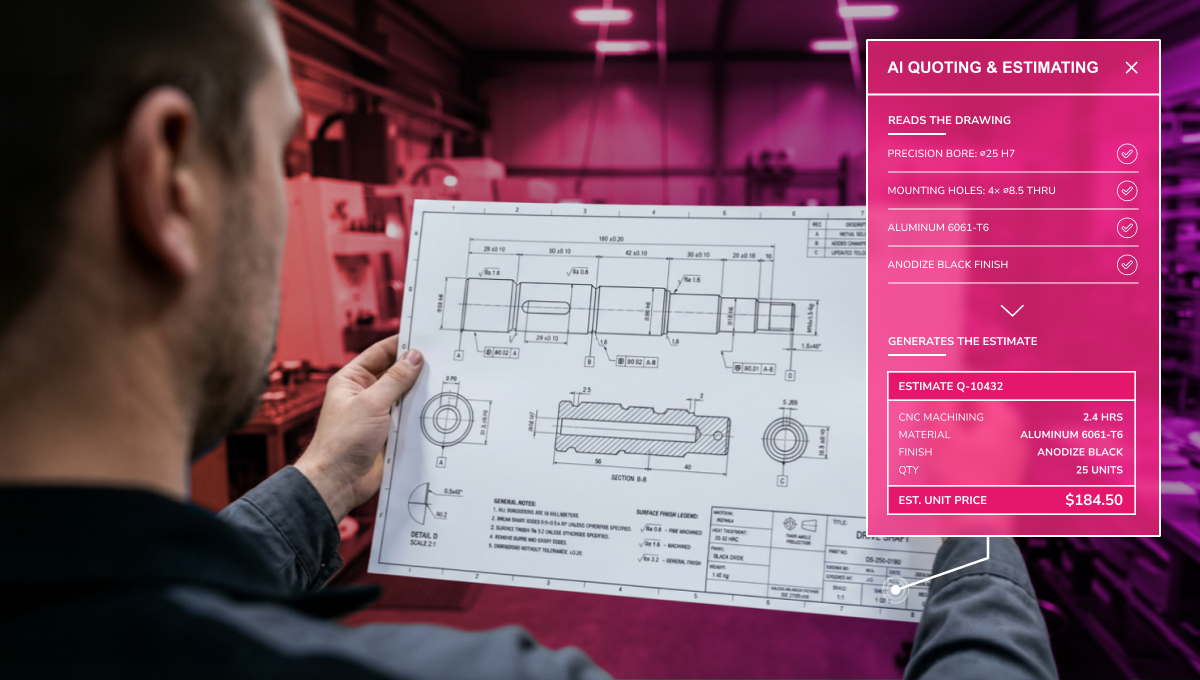
Built for engineer-to-order manufacturers, including structural steel fabricators, machine builders, profile manufacturers and equipment suppliers, it replaces manual takeoff, spreadsheet entry and engineer-dependent quoting with a faster, more consistent workflow. This page covers how AI quoting and estimating works in manufacturing: reading different drawing formats, qualifying RFQs, applying your pricing rules, connecting with your ERP or CRM, and helping your team decide what to quote, how fast, and at what margin.

23 Deloitte Fast 50 Central Europe 2023
Deloitte Fast 50

Forbes Technology Council Official Member
Forbes

1000 Europe’s Fastest Growing Companies
2023 & 2024
Financial Times

Polish Company International Champion 2020
PwC

Master of Innovative Transformation 2021
MIT Sloan Review
Where does quoting capacity get lost?
Get in touch if any of this sounds familiar:
Quoting eats your best engineer’s time?
A customer sends a documentation package for a custom order, and your most experienced engineer spends hours reading drawings by hand before you can even quote. That is exactly the manual work AI can do instead.
RFQs pile up faster than you can quote them?
Every unanswered RFQ is a decision you have not made yet: quote it, decline it, or let it wait. Qualifying fit before anyone opens the file clears the backlog before it grows.
Every quote starts from a blank page?
You have priced something like this before, but finding it means asking around or searching folders by hand instead of reusing what your archive already knows.
Quoting software stops at a single, clean part file?
Off-the-shelf tools are built for a tidy CNC part in STEP format. Your customers send a documentation package: drawings, PDFs, emails, sometimes a sketch. That is what your software actually needs to read.
What makes it different?
Quoting tools price a part. We price a project and compare it with your knowledge.
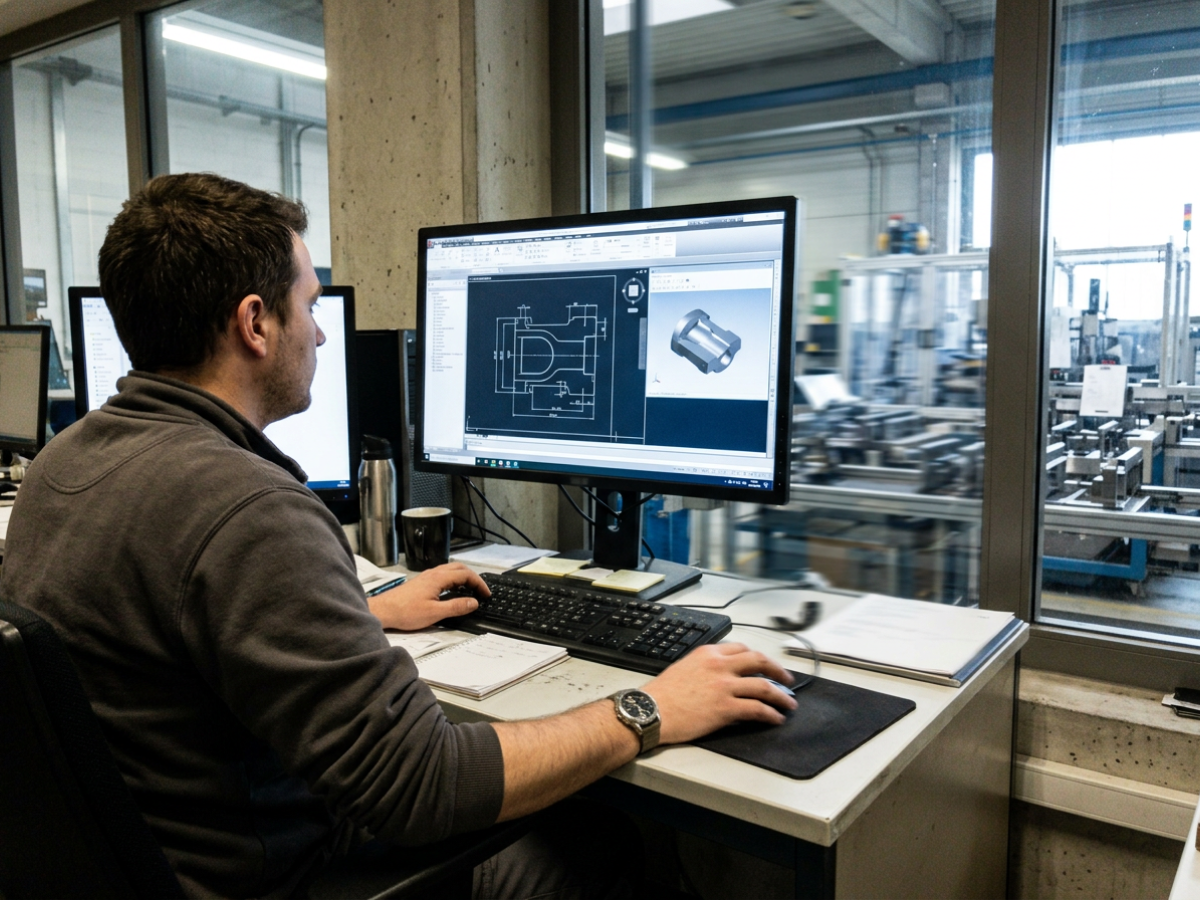
When quoting depends on a handful of key people and hours of repetitive data extraction, response times slow down, errors creep in, and profitable work is easier to miss. AI quoting matters here because it shortens RFQ turnaround, reduces human error, uses your past project data more effectively, and lets engineering focus on decisions instead of data entry.
Quoting tools price a part from a clean CAD file. Your customers send a documentation package: drawings, PDFs, emails, sometimes a sketch. We quote the whole project.
What it does
The system automates the manual, repetitive tasks in the estimating process, takeoff, quantity extraction, re-typing, cross-checking, so your engineers can focus on the decision making a quote actually needs, not data entry.

Reads the package your customer sends
Any format. The customer decides the format, not the software.
Business impact: nothing waits for a specific file format before quoting can start.
Extracts structured data and flags discrepancies
Dimensions, materials and quantities are organised into a project tree and a bill of materials, and discrepancies are automatically flagged before they turn into missed quantities on a quote.
Business impact: manual re-entry is eliminated, and quiet errors get caught before they reach a customer.
Finds the closest past projects in your historical data
Anchors the estimate, so a new quote starts from precedent, not a blank page.
Business impact: institutional knowledge becomes searchable instead of tribal knowledge.

Drafts the quotation using your pricing rules
A person reviews and approves every time. AI proposes, your engineer signs.
Business impact: every quote follows the same pricing logic, whoever is estimating it.
Qualifies incoming RFQs first
A deliberately small first module that answers “is this even our kind of job?” and delivers value within weeks.
Business impact: engineering time goes to jobs worth pricing, not to every inbound email.

Our solution can integrate with your systems
A layer over your existing architecture, not a replacement for it.
Business impact: quoting data has a single source of truth instead of scattered spreadsheets.
What you can extract from drawings with AI?
This question tells you most about how you can utilise AI in analysing your technical drawings. Different file formats contain fundamentally different information, and each one needs a different way of reading it. A scan is only pixels. A PDF has text and lines, but no attached meaning. A DXF has real structure: entities and layers. A STEP file with PMI even encodes some meaning directly: dimensions, tolerances.
| File format | Already in the file (a parser can read it directly) | Missing, has to be recovered by AI |
|---|---|---|
| Scan or photo | Pixels only. | Meaning, structure, and the text and geometry themselves, add BOM info, compare drawing to other documents or historical drawings and projects. |
| Vector PDF | Text and lines, plus the image. | Meaning and structure: what a number refers to, how elements relate, add BOM info, compare drawing to other documents or historical drawings and projects. |
| DXF or DWG | Structure (entities, layers), text and geometry. | Meaning: tolerances, what a dimension actually refers to, compare BOM info from a file to what is actually seen on a drawing, compare drawing to other documents or historical drawings and projects. |
| STEP AP242 | Structure, text and geometry, and some meaning if PMI is present. | Whatever meaning is missing where PMI is absent or incomplete and compare drawing to other documents or historical drawings and projects. |
The hardest part is always the same: meaning. Whether it is a dimension, a tolerance, or which line is a weld symbol, meaning almost never lives in the file itself. It lives in conventions, standards and the engineer reading it.
What are you actually buying? A decision, not an extraction
What every estimating manager needs is better decision making: should we even quote this job? Where is the risk? What will it cost? Have we built anything like it before, and what happened last time?
Your documentation already carries the geometry: weld lengths, cross-sections, cuts, mass, tolerances, applicable standards. Your team carries the coefficients: deposition rates, operating factors, labour and material rates. We read the drawing for geometry and the relationships between its elements, segment it into a workable bill of materials, and let your engineers query it directly in plain language. Combined with your coefficients, that produces material and labour costs, and a price, ready for an engineer to review and sign off as a professional estimate.
Every quote is only as good as the quantities behind it: line items, area and length measurements, material grades, extracted the same way every time. Speed without accuracy just helps you lose money faster on the jobs you win, so both have to come from the same place, not one at the cost of the other.
What’s this worth to your team?
Pick up where you left off?
What changes for your team?
Quoting at the speed of demand with accurate estimates
Your engineers are free from manual drawing analysis at the RFQ stage. More opportunities can be evaluated without adding headcount.

One pricing logic, every time, reducing human error
Your coefficients and pricing rules drive every draft, not a spreadsheet that changes depending on who built it.
Your project archive becomes a working asset
Past projects are searchable and reusable instead of recreated from scratch.

RFQs are qualified before they reach an engineer
A small first module answers “is this our kind of job?” before anyone opens a drawing.
Proof of value before full commitment
Pilots run on your actual drawings and ERP, with success metrics agreed before we start.
ERP and CRM stay your single source of truth
Quoting data flows in and out without replacing the systems you already use.


Looking to cut quoting time without cutting corners on accuracy?
Book a free intro call to see how we can read your documentation package, extract a bill of materials and qualify RFQs before they reach an engineer.

How it works? – Our solution combines parsing with computer vision and ML
A parser reads structure: what is explicitly encoded in the file. In a DXF, a line is a LINE entity on a specific layer, so a parser knows this without guessing, but it only reads what the format already encodes. Computer vision reads an image the way a human eye does: it looks at pixels and recognises text, edges, a weld symbol. It recognises, which means it infers, usually correctly.
We combine both: the parser takes what the file already contains, computer vision recovers the rest. Even together, meaning is still missing on its own, which is why a semantic layer sits above both, the one that knows an “8” refers to sheet thickness and not a page number. That is what lets your engineers query a drawing directly in plain language, instead of just extracting values from it.
We read native CAD, STEP with PMI, DXF and DWG, vector PDFs, and scanned or photographed drawings. What is already encoded, we read directly. What is missing, we recover with computer vision and a semantic layer built for engineering drawings, not general-purpose OCR.
Example types of documents we can work with
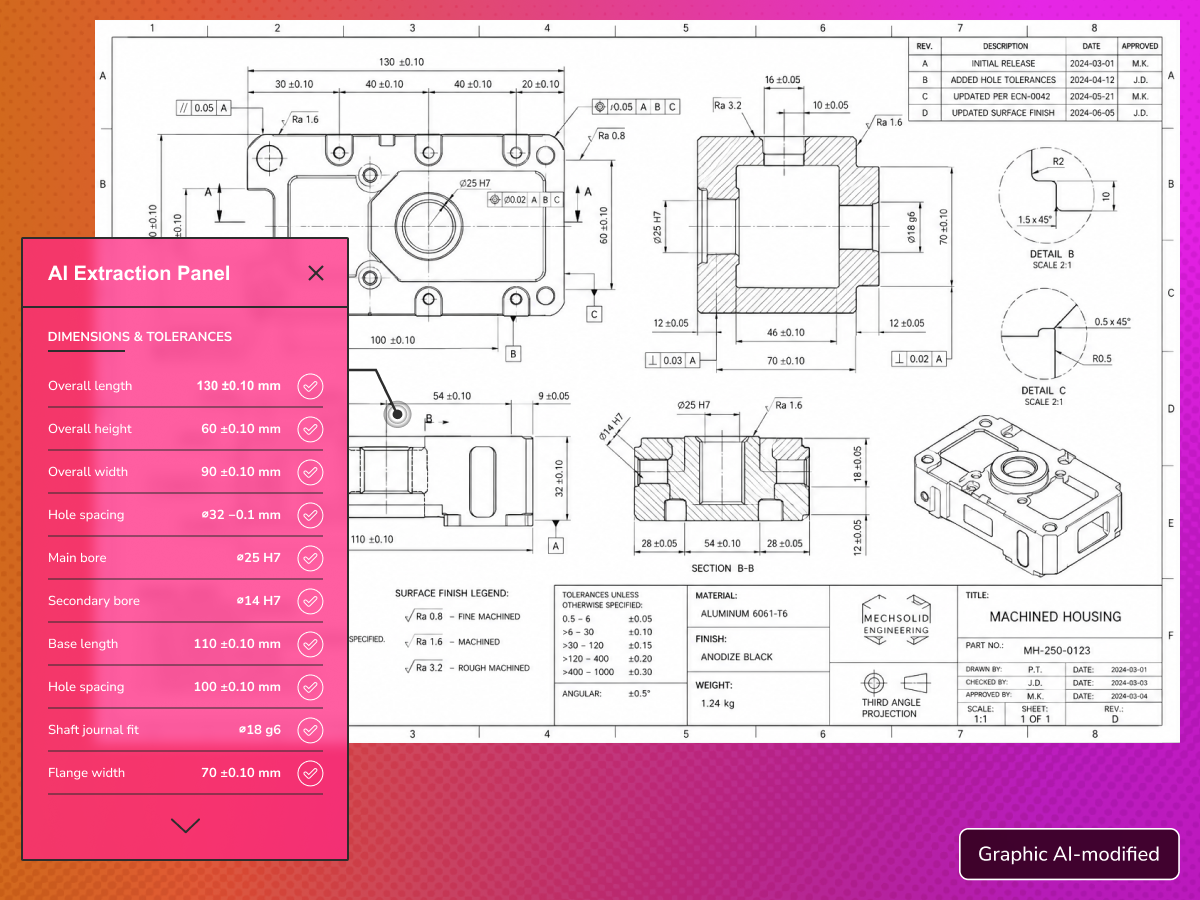
CNC machining drawings
What it is: 2D part drawings (PDF) plus 3D models (STEP), the most common file pairing in metalworking.
What we extract: dimensions and tolerances, GD&T, material, surface finishes, threads, quantities.
Who typically sends it: machine builders, automotive and equipment suppliers, general metalworking shops.
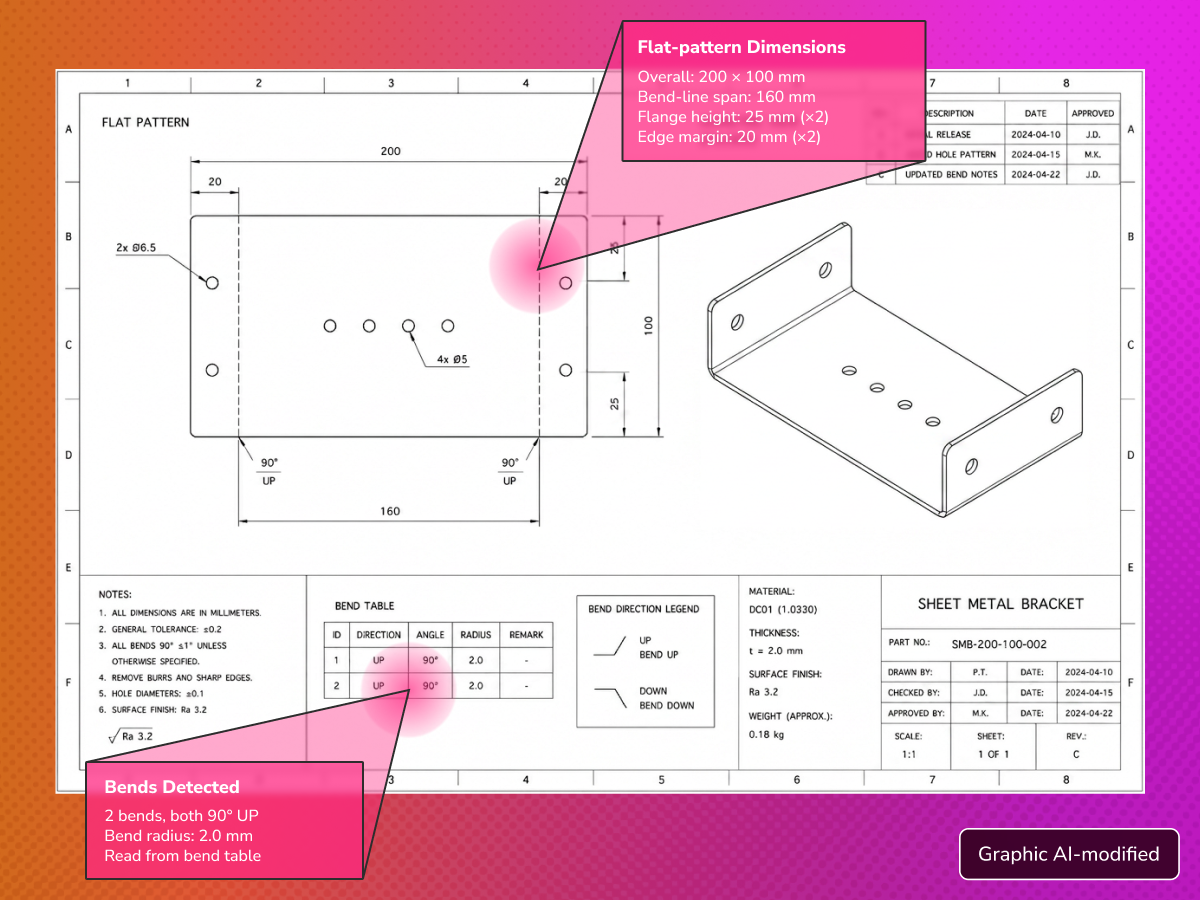
Sheet metal & enclosures
What it is: bent parts, housings and cabinets.
What we extract: material grade and thickness, flat-pattern dimensions, number of bends, cutouts, inserts and hardware, coating requirements.
Who typically sends it: enclosure and cabinet manufacturers, electronics and HVAC suppliers, machine-cover producers.
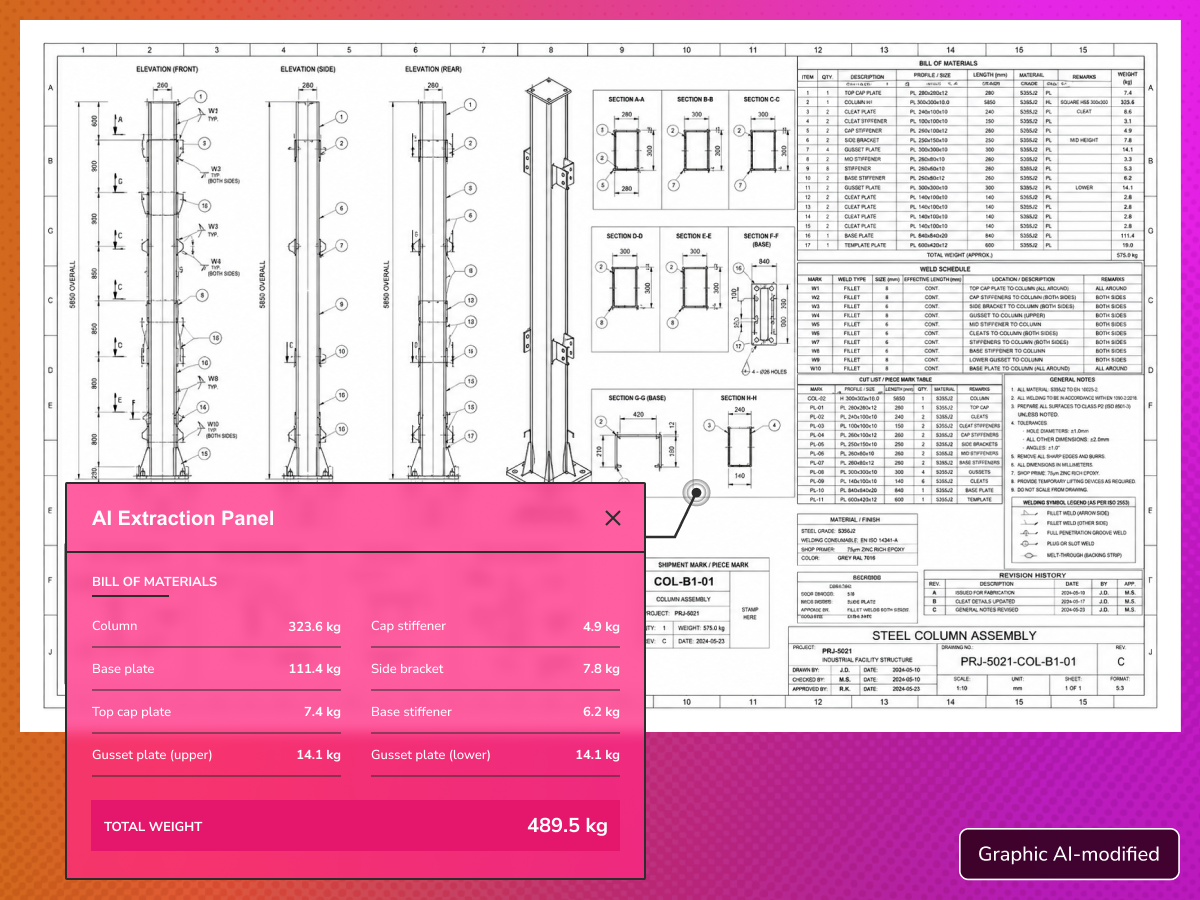
Welded structures & assemblies
What it is: assembly and weld drawings plus 3D models.
What we extract: bill of materials from the assembly, sections and plate thicknesses, weld types and lengths, certificate requirements, critical dimensions.
Who typically sends it: structural steel fabricators, machine-frame and trailer builders, playground and equipment manufacturers.
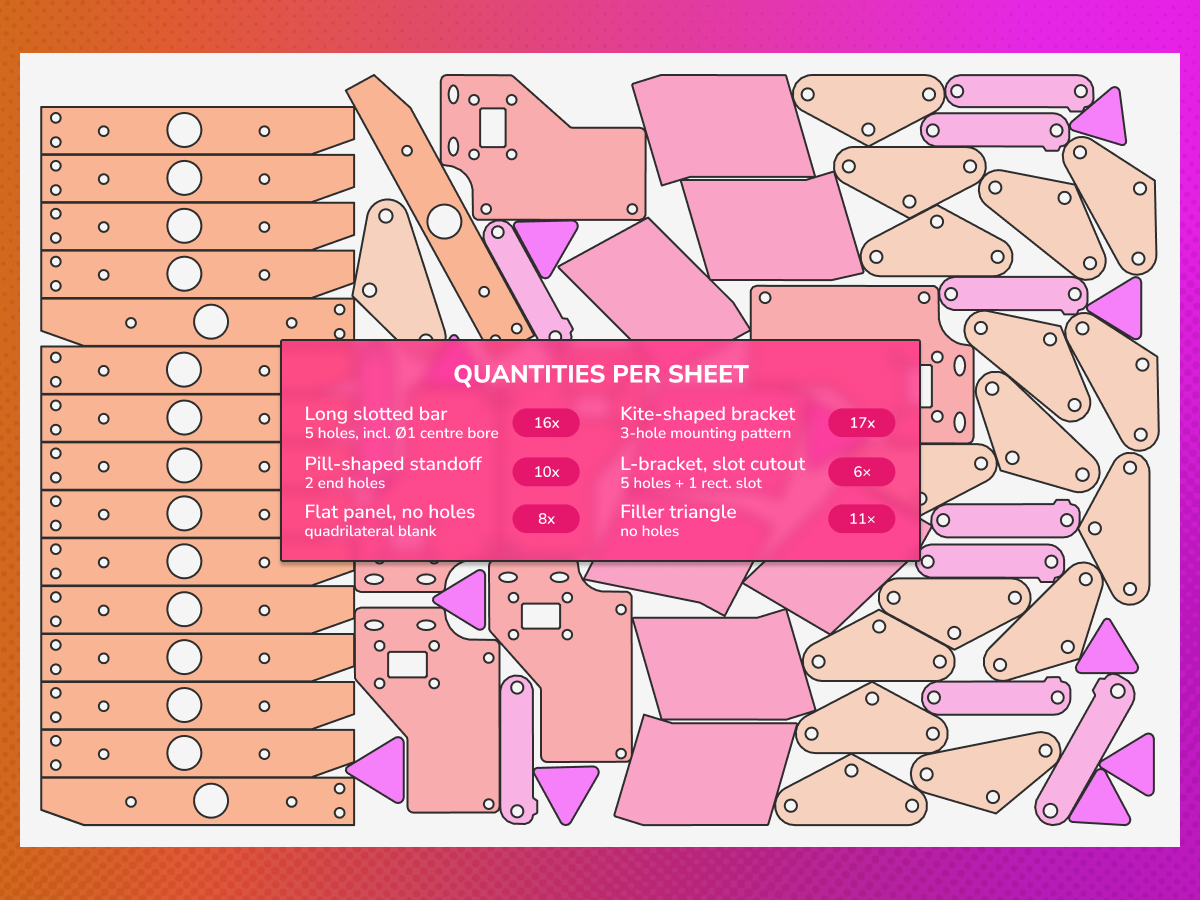
Profiles & 2D cutting
What it is: DXF files and cut plans for laser, plasma and waterjet.
What we extract: contours and cut lengths, hole counts, material and thickness, quantities per sheet.
Who typically sends it: cutting services, profile manufacturers, facade and component suppliers.
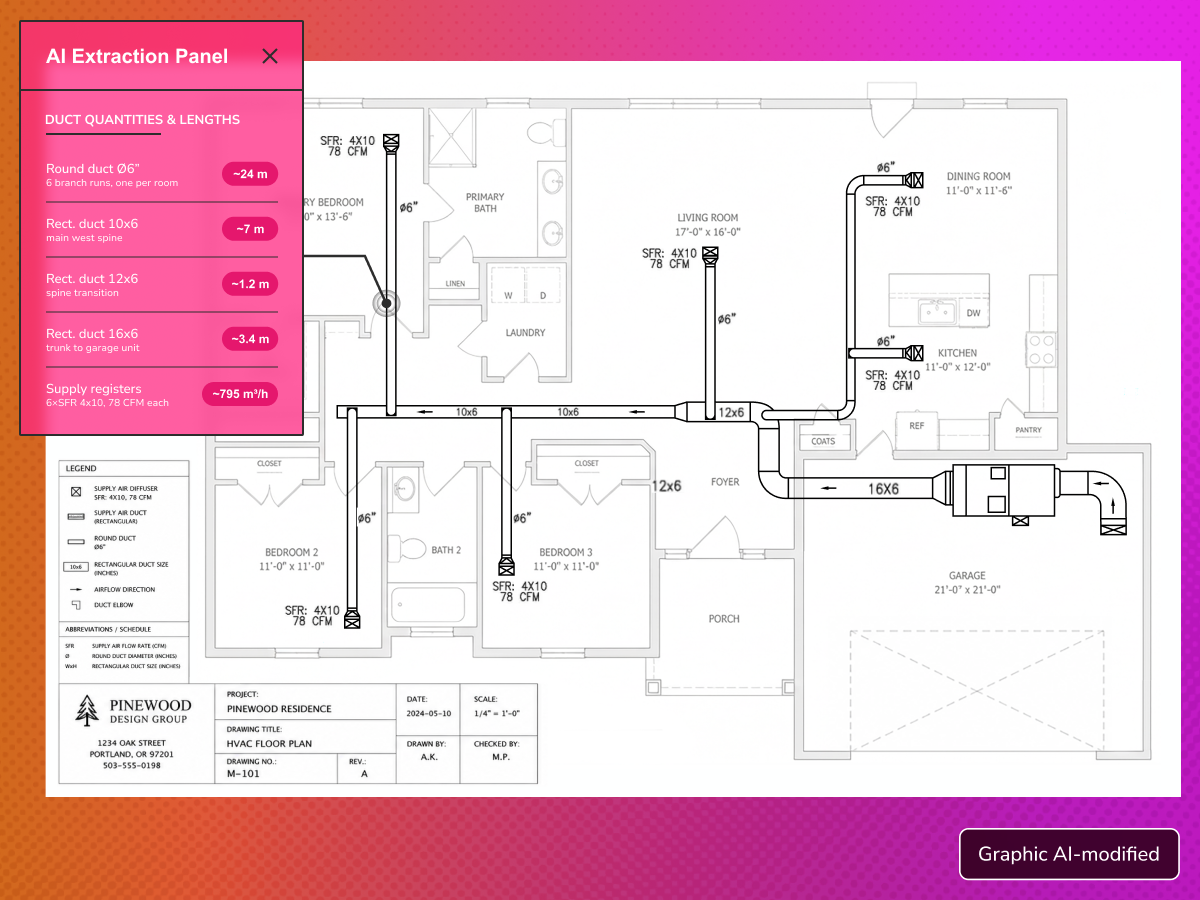
Installation take-off
What it is: building, fire-protection and installation plans requiring a full material takeoff.
What we extract: quantities and area or length measurements of specific elements (dampers, ducts, pipes, cable trays, sprinklers) per floor or zone.
Who typically sends it: fire-protection and HVAC/MEP contractors, building-product manufacturers.
What this looks like on a real RFQ
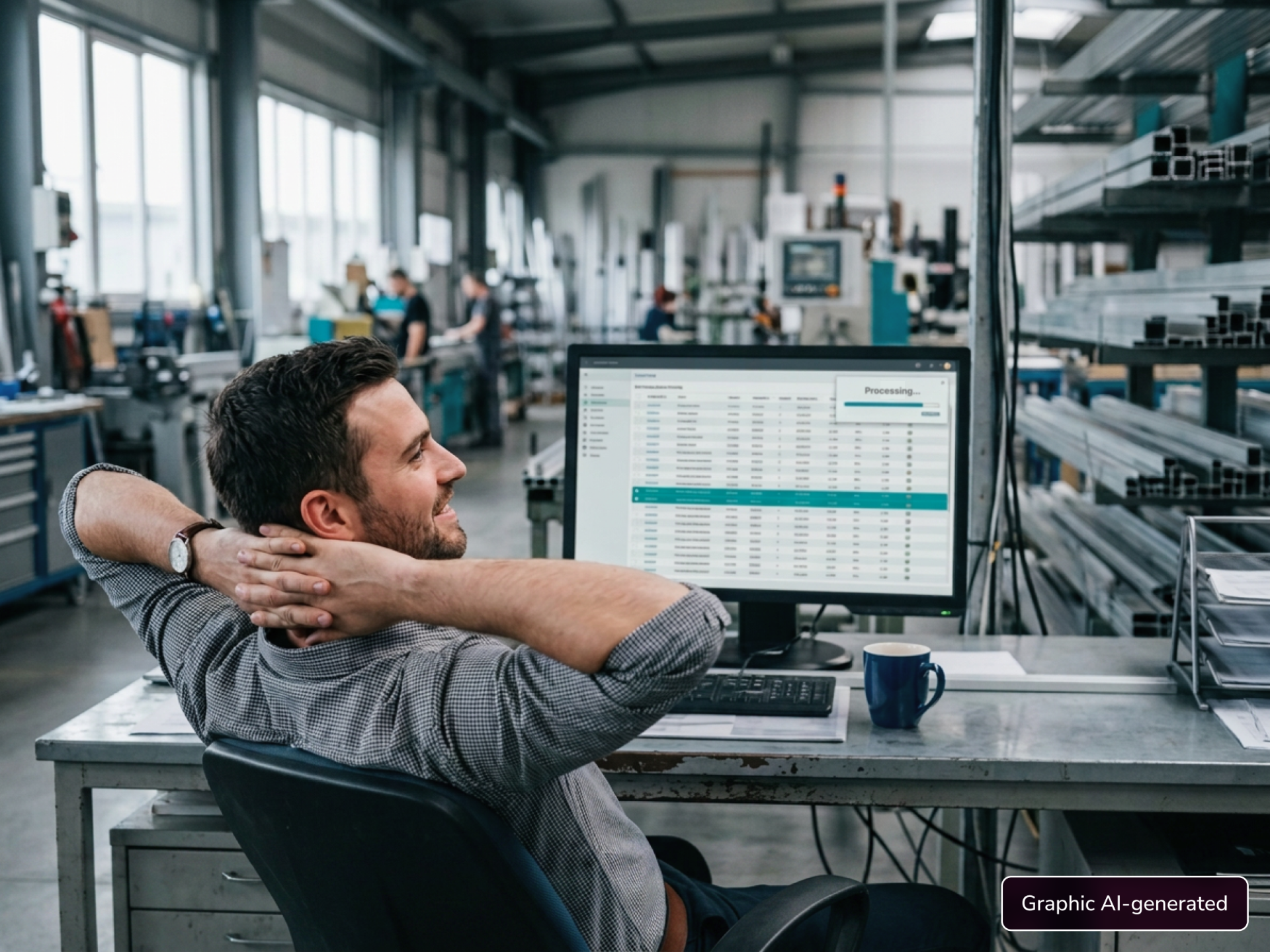
Scenario 1: A profiles manufacturer receives a new RFQ
An assembly drawing and three supporting PDFs arrive by email. Today, one of twelve people manually retypes dimensions and cut lists into the ERP before anyone can price the job.
What changes: the solution reads the same package, extracts the bill of materials automatically, and hands the engineer a draft to check instead of a blank form to fill in.
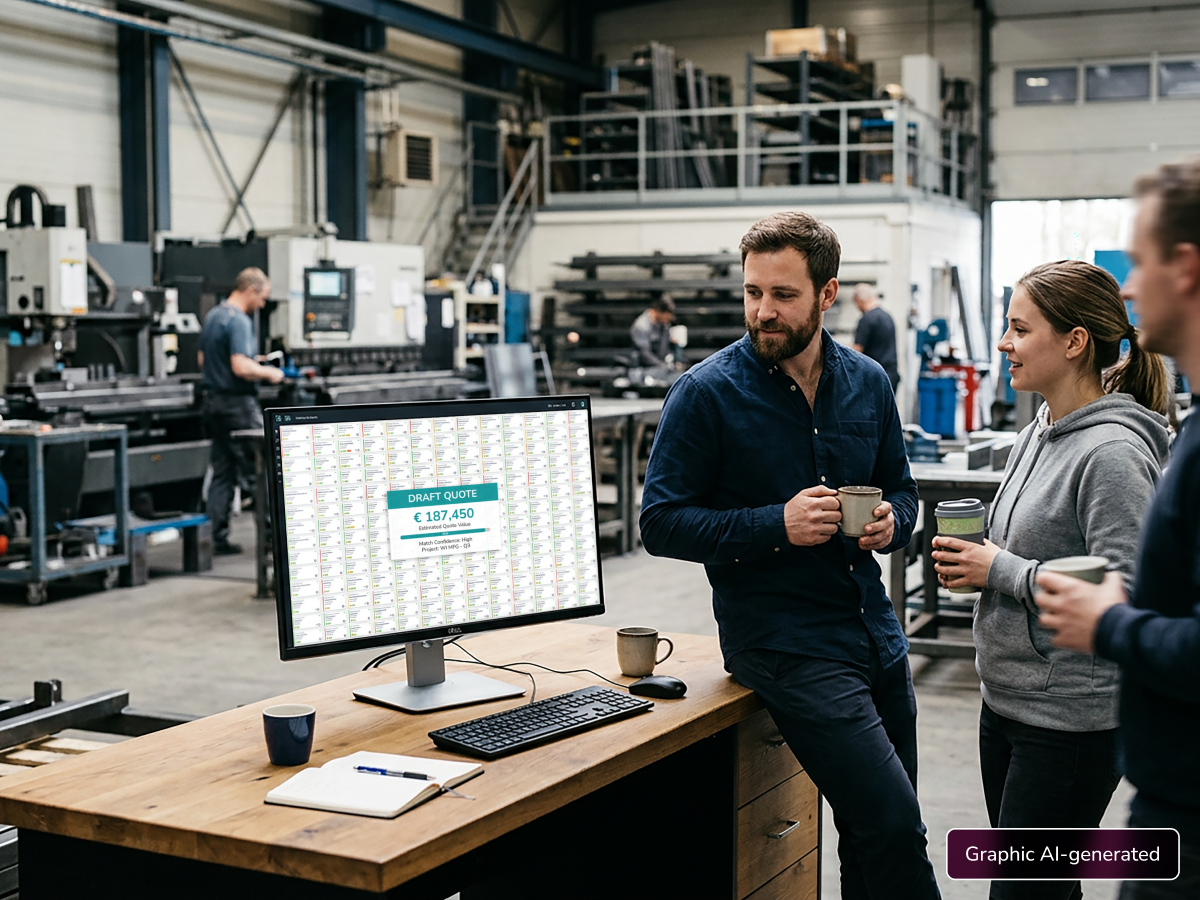
Scenario 2: A metal-processing, engineer-to-order company prices a large project
The project runs to a thousand to ten thousand technology lines, normally a month of work the team does not have.
What changes: the solution segments the documentation into a project tree, finds the closest matching past projects, and drafts quantities and pricing against those precedents, so the engineer starts reviewing instead of starting from zero.
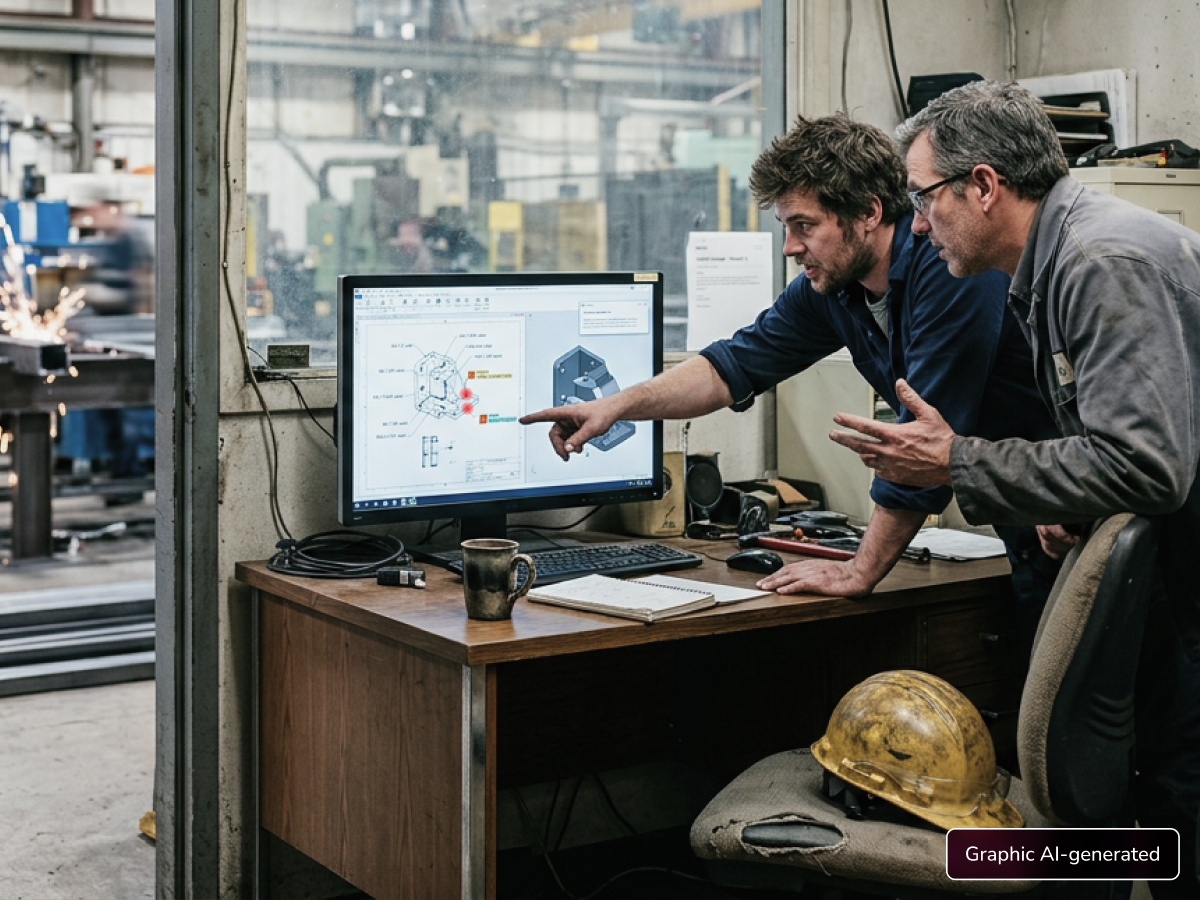
Scenario 3: A structural fabricator sends a welded-frame package
The package includes an assembly drawing with weld callouts, a 3D model and a cover email explaining a change from the last order.
What changes: the solution reads the assembly drawing and 3D model together, extracts a position-level bill of materials with material and thickness per position, and flags anything it is not confident about for the engineer to check before the quote goes out.
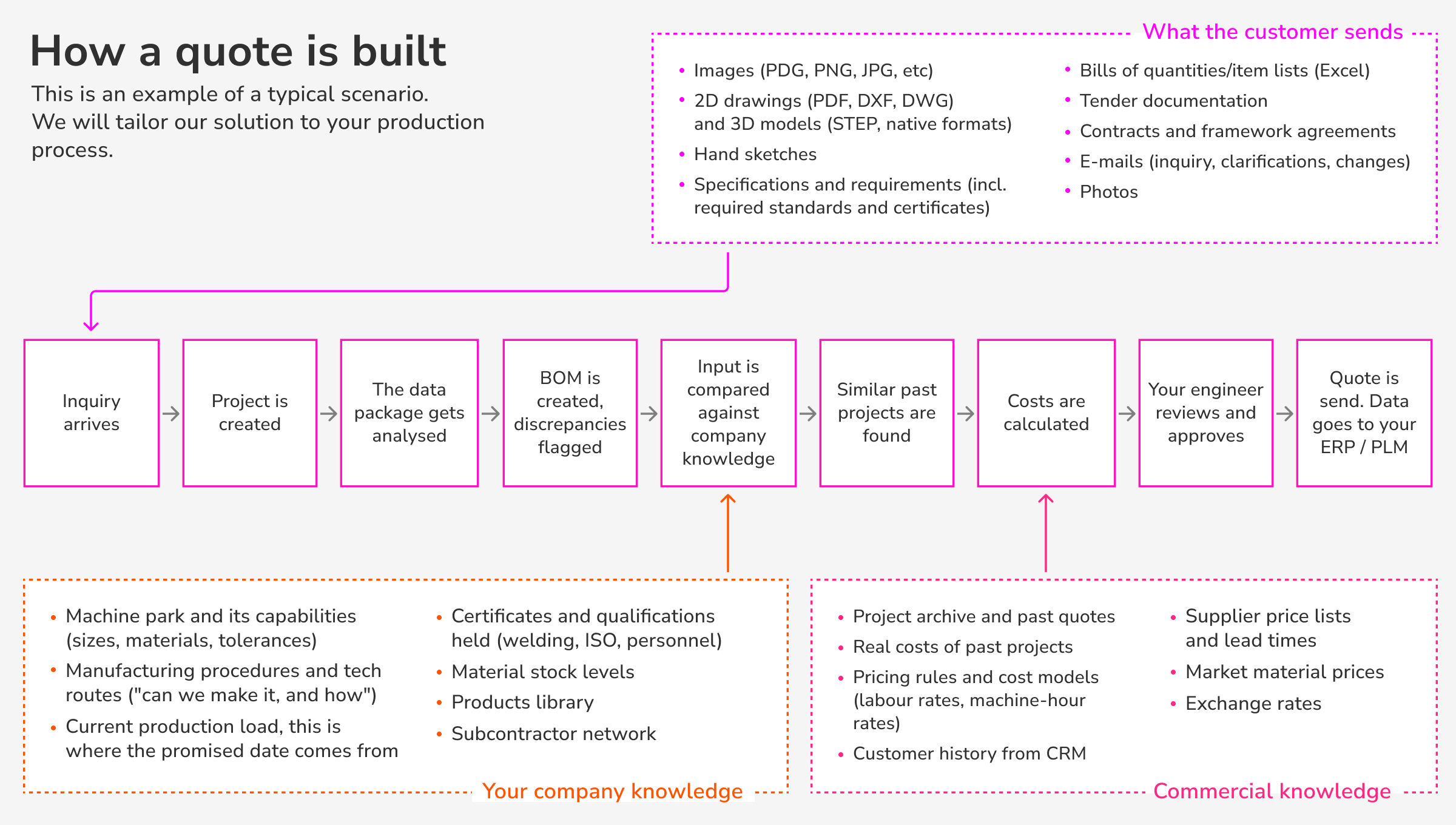
How we do it

Step 01: Free technical consultation
We map your current estimating workflow with your team and give an honest read on where AI helps and where it does not.
Step 2: Workshop and scoping
Your experts plus our technology, together. This is where the knowledge specific to your plant gets captured, and where we agree what clean, standardised data your pilot needs to run on.
Step 03: Pilot on your real drawings
4 to 8 weeks, on your actual documentation, with success metrics agreed before we start.
What we are already hearing from your industry
We have not shipped a finished implementation yet, so we are not going to invent a savings percentage. Here is what discovery conversations with seven to eight engineer-to-order manufacturers have surfaced independently:
“Twelve people manually retype customer drawings into the ERP. Half of them retire within five years.” Said by an operations lead at a European manufacturer of profiles.
“A thousand to ten thousand technology lines per project. That is a month of work we do not have.” Said by an estimating manager at a metal-processing, engineer-to-order company.
Manual estimating is also error-prone by nature, independent of who is doing it. Research on spreadsheet-based work by Ray Panko (University of Hawaii) found that 88 to 94% of operational spreadsheets contain at least one formula error. Quoting that runs on the same manual, spreadsheet-driven process inherits that same risk. This is not a claim about our own results; it is the baseline every manual estimating workflow is already working against.
We are currently in delivery for an engineer-to-order furniture manufacturer. Every pilot we run is measured against an ROI baseline agreed with you before we start, so the result is yours to verify, not ours to claim.
Already trusted us










Built for factories that sign NDAs
Your clients’ documentation is under NDA. Our deployment respects that by design.

On-premise deployment with a local language model.
Your documentation never leaves your plant.
Full audit trail on every extracted value and every quote draft.
You can trace exactly how any quote was built.
Human approval by default.
Nothing reaches a customer without an engineer’s sign-off.
ISO 27001 certified.
Independently audited, covering how we store and process your data.
What are examples of AI development services from DAC.digital?

About DAC.digital
Thirteen years building AI for real industrial environments, with 150+ engineers including ML and computer vision specialists.
We built the computer vision systems behind Komatsu’s autonomous forestry equipment, eliminated defects in furniture production, and developed automated inspection systems for complex technical assemblies. AI quoting and estimating for engineer-to-order manufacturing is our next frontier.
Recognised as one of Deloitte and FT’s fastest-growing companies four times, ISO 27001 certified, with enterprise-grade security.





Subscribe our Newsletter
Anything else we should know?
Optional, and you are already subscribed. It only helps us write for the right reader.
You are on the list.
The next one lands in your inbox. Nothing else — we do not pass your address on.
FAQ
What is AI estimating software for manufacturing, and can it really extract a bill of materials from a welded assembly drawing?
AI estimating software for manufacturing uses artificial intelligence to read a customer’s technical drawings and documentation, and automates the manual, repetitive tasks in the estimating process: identifying specific elements, extracting geometry and accurate quantities such as dimensions, materials, weld lengths and cut counts, and drafting a cost estimate for material and labour costs using your own pricing rules. For engineer-to-order manufacturers, that covers welded structures, sheet metal, cut profiles and installation take-off, not just a single CNC part. Manual processes like re-typing dimensions from a drawing no longer stand between an RFQ and a professional estimate. Yes, extracting a bill of materials from a welded assembly drawing is exactly what our demonstration shows: a position table read directly from the 2D drawing, fused with the 3D model, with material and thickness listed per position. The solution identifies weld types and lengths, section and plate thicknesses, and certificate requirements from the assembly drawing, then structures all of it into a bill of materials an engineer can check against the source drawing in minutes. A person still reviews and approves every estimate before it reaches a customer.
How does AI reduce manual effort, human error and takeoff time, without sacrificing accuracy?
Manual effort in quoting comes down to a handful of manual tasks that are repetitive and time-consuming: re-typing dimensions, tracing weld lengths, counting elements and cross-checking quantities across a documentation package by hand. Each manual step is a chance for human error to enter a quote, and manual counting is where missed quantities and quiet mistakes creep in. AI-powered estimating tools and AI-driven estimating tools automate those specific tasks: reading the package, extracting area measurements and length measurements, flagging discrepancies, so your engineers can focus on the judgment calls a quote actually needs, pricing risk and reviewing the draft, not data entry. The takeoff process, counting elements, measuring lengths and areas, building a bill of materials, is where most manual estimating time goes, so this is also where takeoff time drops first, and where the significant time your team already loses gets recovered. Every reading stays flagged for confidence and reviewed by a person before it reaches a quote, so you get both the speed and the accuracy, not one at the cost of the other.
How is this different from Paperless Parts, Spanflug or an industry-specific quoting tool?
Most AI tools and AI-powered estimating tools on the market today, Paperless Parts and Spanflug included, quote a part from a clean CAD file, and both are built around CNC machining. We quote a project: the documentation package your customer actually sends, drawings, PDFs, emails, sometimes a sketch, across welded structures, sheet metal, cut profiles and installation take-off, not just a single part file. We also specialise by file format, not by industry: a welded assembly drawing in STEP or DXF follows the same logic whether it comes from a structural steel fabricator, a trailer builder or a playground equipment manufacturer, so we do not ask you for a case study from your exact sector. The detail specific to your plant, your standards and your pricing rules gets captured in a scoping workshop instead. We build a custom system assembled from proven components and scoped to your estimating workflow, rather than selling one fixed SaaS product, and that is also how you stay competitive on turnaround time instead of competing on price alone.
We already started building this in-house, can you still help?
Good, that means you already understand the problem. Most in-house builds stall on the extraction and search layer, which is the hardest and slowest part of the estimating process to get right: reading varied drawing formats reliably, and finding similar past projects in your historical data to anchor a new estimate. We can plug in as the missing component, drawing extraction, project-history search, or the quoting layer on top of what you have already built, instead of asking you to replace it. A phased approach like this also makes AI adoption easier for your team: you get one working piece proven before you commit significant time to rebuilding the whole thing.
Our documentation is under NDA, and we are worried about wrong quotes: how do you handle that?
Both come down to the same design choice: nothing leaves your control without a person checking it first. Deployment is on-premise with a local language model, so your clients’ documentation never leaves your plant, and every extraction and every quote draft carries a full audit trail. Every AI-drafted quote goes to a person before it reaches a customer: low-confidence extractions are flagged rather than silently guessed at, and every reading stays visible and editable. AI proposes, your engineer signs. No other quoting tool in this category offers on-premise deployment with a local model, and ISO 27001 certification covers the rest of how we handle your data.
What does it cost?
There is no list price, because there is no off-the-shelf product to price: what you get is a custom solution assembled from proven components, scoped to your estimating workflow and your drawing type. We start with a free technical consultation (30 to 60 minutes with a senior engineer, no commitment), move to a scoped workshop where your experts and our technology map the detail specific to your plant, then price a pilot against the scope we agree together, typically 4 to 8 weeks on your real drawings with success metrics agreed before we start. You know exactly what you are paying for, and what efficiency you should expect to measure, before you commit to anything.
Ready to tell us about your project? Describe what you’re working on in the form below.
Contact us!
Send us an email: [email protected]