


Agentic AI in Manufacturing
Agentic AI systems let manufacturers automate planning, data analysis, and shop-floor decisions instead of just answering questions.

DAC.digital designs and builds agentic AI systems for manufacturing environments: AI agents that read your operational data, follow your procedures, and act autonomously inside the enterprise systems you already run, covering production schedules, quality control, and maintenance alike.

23 Deloitte Fast 50 Central Europe 2023
Deloitte Fast 50

Forbes Technology Council Official Member
Forbes

1000 Europe’s Fastest Growing Companies
2023 & 2024
Financial Times

Polish Company International Champion 2020
PwC

Master of Innovative Transformation 2021
MIT Sloan Review
What is an agentic AI system, and how can manufacturing benefit from it?
An agentic AI system is AI that takes autonomous, goal-oriented action. It is built on top of large language models such as ChatGPT or Gemini, which normally respond to a single prompt. An agentic system goes further: it continuously perceives signals from the factory environment, reasons about production goals within defined constraints, takes action, and learns from outcomes. It plans, checks its own work, uses tools, queries data sources, and retries when something fails.
For manufacturers, this means an AI agent can handle planning, task execution, data analysis, and environment monitoring on its own, while coordinating decisions and execution across manufacturing operations and working with human operators when approval, exception handling, or shop-floor expertise is needed. Agentic AI in manufacturing typically connects to existing manufacturing systems and manufacturing workflows, including Manufacturing Execution Systems (MES), SCADA, ERP, Product Lifecycle Management (PLM) platforms, programmable logic controllers, CMMS, and IoT sensor data, to turn scattered data into decisions and actions with minimal human intervention. This applies across enterprises, scale-ups, and startups running regulated or technology-intensive manufacturing operations.
How agentic AI differs from traditional automation
Traditional automation and programmable logic controllers execute predefined tasks: fixed rules, fixed sequences, no adjustment when conditions change. Agentic AI systems reason across multiple steps, adapt production priorities when a delay or defect appears, and only fall back to human approval when a decision falls outside their safety constraints. These same capabilities support administrative and logistical autonomy, shop-floor copilots, computer vision, predictive maintenance, and compliance workflows, the applications covered throughout this page. For manufacturers under pressure to reduce repetitive manual work, catch defects earlier, preserve operational know-how, and improve decision speed and quality, this shift can translate into measurable efficiency gains and a stronger competitive position.
Book agentic AI consulting and learn what your organisation needs to design a robust multi-agent system architecture.

Where do manufacturers lose time and money today?
Get in touch if any of this sounds familiar:
Administrative work eats into production time
Documentation, ordering, invoicing, and internal logistics run on manual steps that were never designed to scale with your output.
Operational data sits in five different systems
Manufacturing execution systems, SCADA, ERP, CMMS, and spreadsheets all hold a piece of the picture, but nobody has timely access to the full production data needed before a decision is made. Legacy systems that were never built to talk to each other make data integration and system integration harder than they should be.
Knowledge lives in people’s heads, not in your systems
Line operators and maintenance staff solve the same problems repeatedly because past fixes, tolerances, and root causes are not written down anywhere searchable.
Quality control depends on manual inspection
Defects are caught late, after material and machine time are already spent, instead of at the point where they could be prevented.
How manufacturers use agentic AI: three core applications
Agents support documentation, ordering and invoicing, internal logistics, and data reporting and archiving. Multi-agent systems coordinate autonomously across these processes, cross-analysing data and creating value from information you already collect.
Workflow automation across existing systems
An agent specialises in one part of a workflow and coordinates with other agents to share context and complete the work.
Purchasing, MRP, and inventory agents
The agent monitors inventory levels, generates orders, communicates with suppliers, predicts stock-outs, and verifies delivery compliance.
Production planning and supply chain agents
The agent adjusts production schedules and production priorities using live data on supply chain disruptions, market trends, and customer data, and supports supply chain coordination across suppliers, warehouses, and production lines without waiting for a weekly planning meeting.
This segment is growing quickly, as more and more organisations are using ai technology to aid their office tasks. In manufacturing, as some administrative work is an afterthought, it can lead to a lot of ‘process waste’. The agent can perform repetitive office processes that are a significant cost in factories”.

AI agents can collect, merge, and interpret operational data
This is one of the fastest-growing areas of agentic AI adoption in manufacturing environments, because it works with data plants already have, spread across MES, SCADA, ERP, CMMS, IoT sensor data, and spreadsheets.
A specialized agent retrieves data from multiple systems, builds context (for example, “material delivery delayed by 30 minutes, which changes the setup”), generates insights or reports, monitors KPIs such as unplanned downtime, scrap, and OEE, detects anomalies in equipment failures, supports manufacturing tasks, and issues actions such as creating a ticket in the CMMS. Reliable data integration and data quality across these systems are what make this level of automation possible.
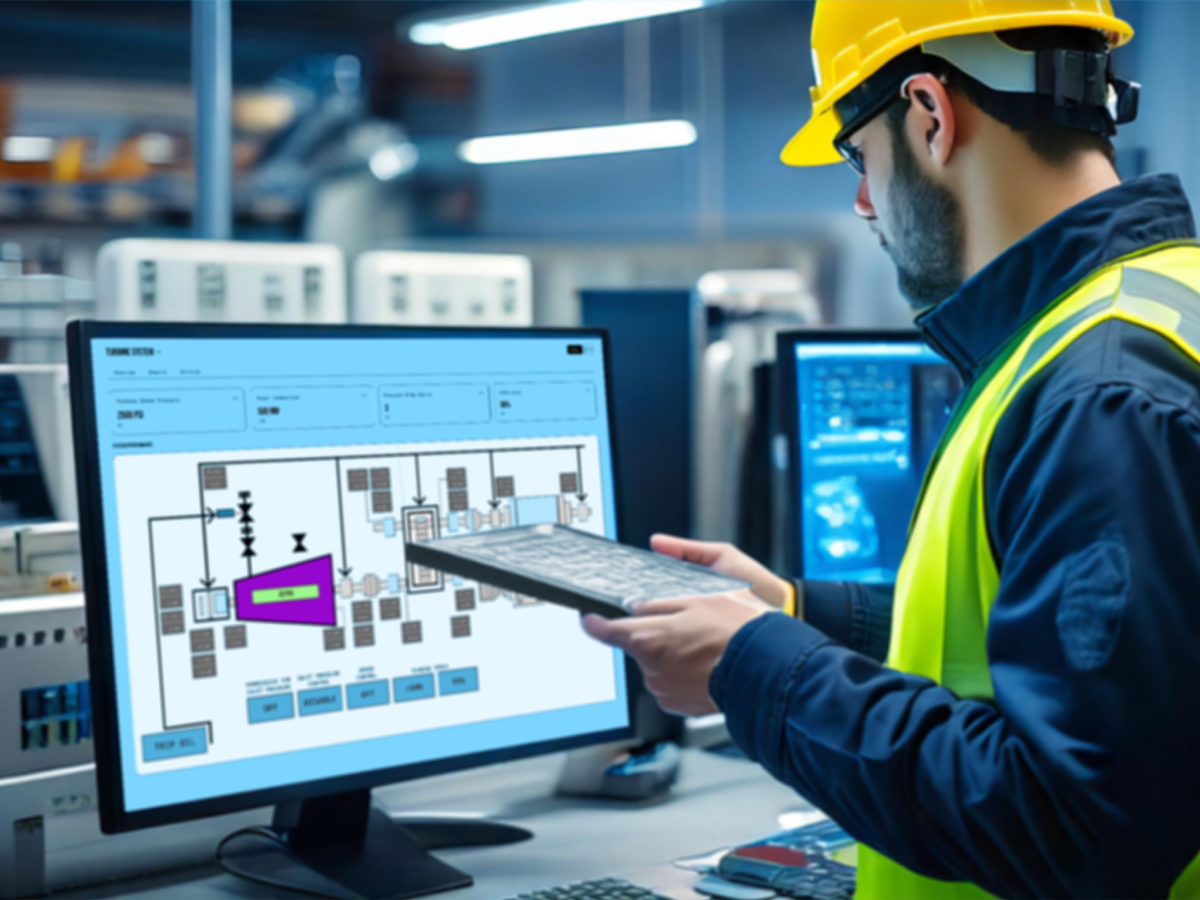
Examples of agents that analyse data
Reporting agent
An LLM-based system that automates shift reports, production reports, energy consumption reports, and waste reports.
Process data quality agent
An assistant that identifies gaps, deviations, and recording errors.
Diagnostic agent
An agent that derives correlations, for example the impact of line parameters on quality.
Agentic AI copilots can support workers on the shop floor
An AI copilot works alongside your employees on routine tasks, making their work scalable and fast.
The goal is to move from manual knowledge searches, dashboard building, and passed-along information, toward automated data flow and proactive optimisation. The exact functions of a copilot depend on your employees’ needs, the specifics of your facility, and the engineering and manufacturing tasks they need to support.
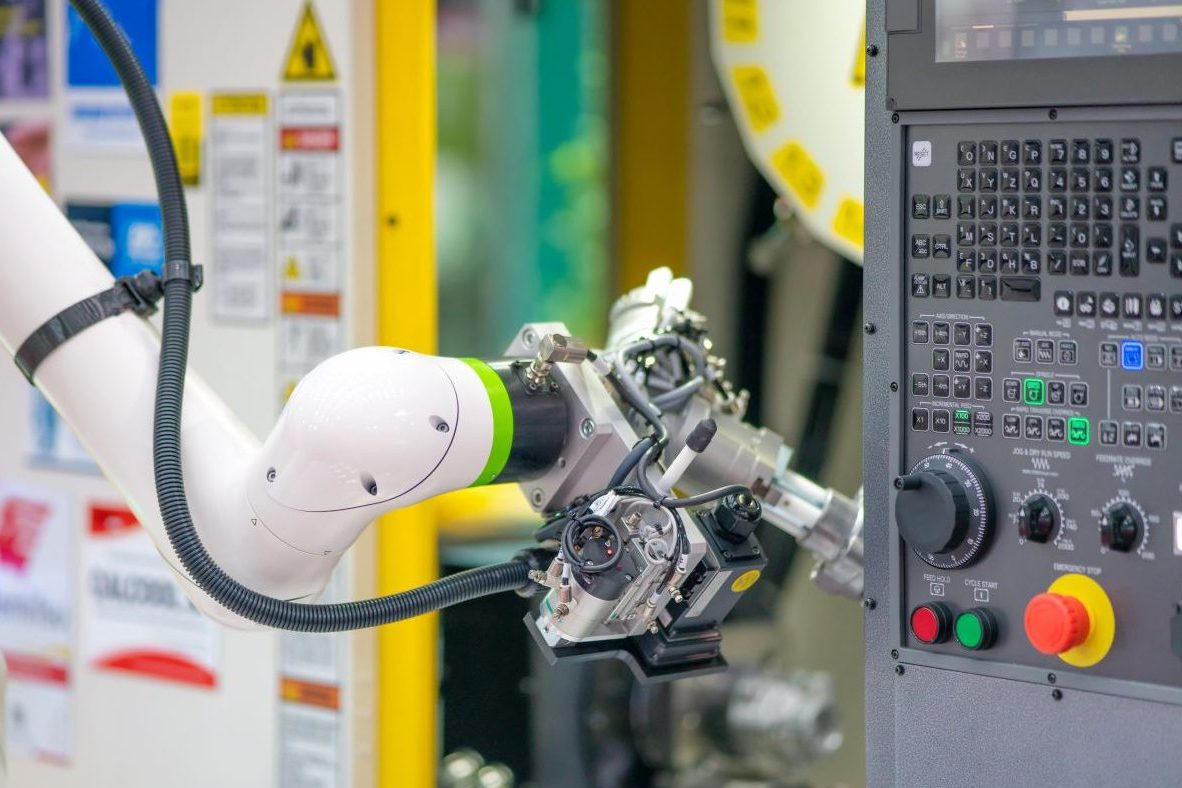
Examples of agentic AI copilots on the plant floor
Line operator copilot
Answers questions about procedures and set-ups, guides parameter tolerances, walks operators through a changeover step by step, detects parameter deviations and suggests corrections, and helps identify the root cause of scrap.
Maintenance copilot
Accepts calls from the line by voice, tablet, or chat, automatically creates tickets, analyses failure history and parameters, suggests diagnostic procedures and spare parts, and monitors SLA status.
Quality control copilot
Analyses images and video from cameras alongside process parameters, classifies defects automatically, and explains the causes of deviations. It can close the loop on its own: if it detects a trend of quality deterioration, it can suggest machine setting changes.
Beyond structured data: visual, predictive maintenance, and compliance intelligence
A multi-agent system can go further than dashboards and reports, using specialized agents to add visual, predictive, and compliance capabilities on top of the same architecture.

Examples of agents who can go beyond standard tasks
Computer vision-based agent
A bespoke computer vision algorithm with an added agent layer that responds to results by integrating sensor data from cameras and existing systems, supporting defect detection at the point of production and faster action on the production line.
Predictive maintenance agent
An agent with machine and failure memory, built for predictive analytics on machines and production processes, using machine learning to forecast equipment failures before they cause unplanned downtime, adjusting maintenance scheduling and recommendations over time instead of reacting after a breakdown.
Compliance agent
Feed the agent your specialised procedural knowledge, and it automates compliance checks, acts as a knowledge base, and flags when regulations change.
These capabilities depend on connected sensor data and a solid IoT layer across the plant. See IoT solutions for Industry 4.0 for how DAC.digital builds that foundation for smart manufacturing.
Independent research on predictive maintenance backs up why this pillar matters: the U.S. Department of Energy found predictive maintenance programs cut maintenance costs by 25 to 30 percent on average, and a 500-plant survey found an average 30 percent increase in equipment availability after adoption (U.S. DOE, summarised in maintenance industry benchmarks). McKinsey research puts overall maintenance cost reductions at 18 to 25 percent for similar programs.
A ready example: agentic AI for technical drawings and CAD files
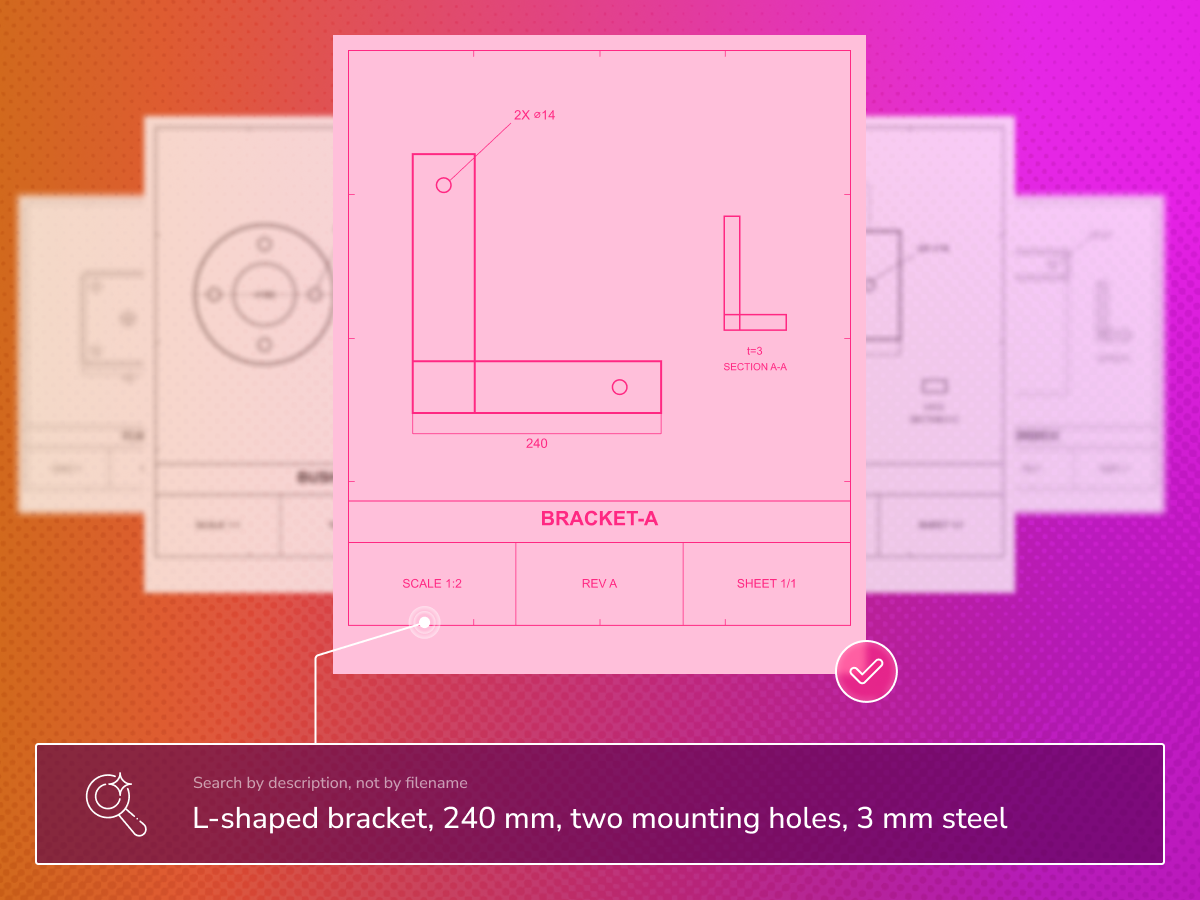
One of the clearest, fastest-to-deploy applications of agentic AI in manufacturing is reading and acting on technical drawings and CAD files.
Engineering-to-order manufacturers lose specialist hours to manual drawing analysis, quoting, nesting, and searching past projects for a design that already solved today’s problem.
DAC.digital built a dedicated agentic AI solution for exactly this: it reads geometry, dimensions, and spatial relationships across CAD/CAM files, searches your project history semantically, and connects to your ERP and CAD systems without disrupting how your engineers already work.
Why manufacturers are accelerating agentic AI adoption now
Agentic AI adoption in manufacturing is accelerating faster than most enterprise software categories. Gartner predicts that 33 percent of enterprise software applications will include agentic AI by 2028, up from less than 1 percent in 2024, and that at least 15 percent of day-to-day work decisions will be made autonomously through agentic AI by the same year, up from 0 percent in 2024 (Gartner).
That growth comes with a warning worth taking seriously: Gartner also predicts that over 40 percent of agentic AI projects will be canceled by the end of 2027, mainly because of escalating costs, unclear business value, or inadequate risk controls, not because the technology fails. The projects most likely to survive start with a narrow, well-defined use case and a clear way to measure business value by tracking KPIs tied to agentic AI investments, rather than an open-ended “implement agentic AI everywhere” mandate.
Integrating agentic AI with what you already run is usually the hard part, not the AI itself. In supply chain management specifically, Gartner survey data shows 56 percent of chief supply chain officers say integrating AI with legacy systems is a major challenge, and half report limited internal expertise to do it (Gartner). This is exactly why DAC.digital scopes every engagement around your existing systems and data quality first, because embracing agentic AI works best as a practical, phased adoption path, not a broad rollout. Done well, those deployments become a step toward autonomous systems in manufacturing rather than isolated tools.
Which agentic AI services does DAC.digital provide?
With experience in platform development, embedded systems, IoT, and computer vision, our team can advise you on adding agentic AI to your existing systems or build AI agents from the ground up. We build agent-first applications, integrate agents with your systems, and design the agentic architecture your operation needs, including orchestration for multiple specialized agents in complex workflows.

Agentic AI consulting
Agentic architecture design that aligns with business outcomes.
Our process maps goals to technical solutions, evaluates feasibility, and sets best practices for monitoring, governance, and multi-agent coordination.

Agentic AI development
Custom AI agents built for your specific business needs.
They are able to use domain knowledge, integrate with existing workflows, and include full observability for traceability, performance, and increased operational efficiency across connected workflows.
What changes for your team

Less time lost to manual, repetitive work
Administrative and reporting tasks that used to take hours run in the background, monitored rather than performed by hand.
Faster, better-informed decisions
Instead of waiting for someone to pull data from five systems, operators and managers get monitored KPIs, anomaly alerts, and suggested actions as they happen, improving overall process efficiency through real-time decisions.
Defects caught earlier
Quality control copilots connect camera data with process parameters, so deviations are flagged and explained before they turn into scrap or downtime.
Institutional knowledge stops walking out the door
Diagnostic history, root causes, and procedures become searchable and reusable, instead of depending on which operator happens to be on shift.
Independent research points in the same direction: manufacturers using AI in production report operating efficiency gains in the range of 20 to 30 percent, and quality defect reductions of around 35 percent, according to industry benchmarks compiled by Acuvate. These are industry-wide figures, not a guarantee, and actual results depend on your data, processes, and scope, and operational costs will vary by facility.
Human oversight: what stays under your control
Autonomous does not mean unsupervised. Every agentic AI system we build operates inside safety constraints and production priorities that your team defines, with human approval required for any action above an agreed risk threshold. Human expertise stays in the loop by design, not as an afterthought.
In practice, this means: your engineers can see which agent, model, or prompt produced a given output; low-risk, repetitive decisions run with minimal human intervention, while higher-stakes actions (a schedule change, a supplier commitment, a quality hold) route to a person for sign-off; and every autonomous action is logged for audit, not just for compliance, but so your team can see exactly why an agent made a call.
This governance layer is also why some agentic AI projects succeed and others don’t. Gartner’s research into why over 40 percent of agentic AI projects are expected to be canceled by 2027 points to unclear business value and inadequate risk controls, not the underlying technology, as the main causes of failure. Building oversight and observability in from day one is how DAC.digital’s AgentOps services keep that risk down.
The right approach depends on the type of project
Enterprises
Enterprises need agents with domain-specific expertise, structured workflows, and security and compliance built in from the start. They need agentic infrastructure that lets them trace which prompt or model produced a given output.
Startups
Startups and scale-ups get lean, scalable agent architectures that avoid over-engineering, along with guidance on monitoring and observability so the system stays manageable as it grows.
How we work
Step 01: Free technical consultation
A senior AI engineer joins a short call with your team to map your current workflows, systems, and the specific problem you want to solve first.
Step 2: Scoping and pilot design
We define a structured pilot for implementing agentic AI that fits your systems, data, and risk tolerance, with a fixed scope and clear success metrics agreed upfront.
Step 03: Pilot on your real data
The agent runs on your actual systems and workflows, so you can evaluate its impact on manufacturing operations before committing to a full rollout.
About DAC.digital
Thirteen years building AI for real industrial environments, with 150+ engineers including ML and computer vision specialists.
We built the computer vision systems behind Komatsu’s autonomous forestry equipment, eliminated 90% of defects in furniture production, and developed automated inspection systems for complex technical assemblies.
Recognised as one of Deloitte’s and FT’s fastest-growing companies four times, ISO 27001 certified, with enterprise-grade security throughout. Across the manufacturing industry, that combination of production experience and AI engineering is what turns an agentic AI pilot into a lasting competitive advantage rather than a stalled experiment.
Subscribe our Newsletter
Anything else we should know?
Optional, and you are already subscribed. It only helps us write for the right reader.
You are on the list.
The next one lands in your inbox. Nothing else — we do not pass your address on.
FAQ
Agentic AI in manufacturing refers to AI systems that take autonomous, goal-oriented action inside production environments: agents that monitor data, make decisions, and execute tasks such as reporting, quality checks, or inventory management, rather than only answering prompts.
Traditional automation and RPA follow fixed, pre-programmed rules. Agentic AI plans, reasons across multiple steps, adapts to changing conditions, and can self-correct when a step fails, without needing to be reprogrammed for every new scenario.
No. Agentic AI connects to the systems you already run and pulls context from them. The goal is to make existing data actionable, not to replace the platforms your team already relies on.
Most engagements start with a short workshop or pilot scoped to a single, well-defined use case, typically running a few weeks. Full rollout timelines depend on the number of systems involved and the complexity of the workflow.
Yes. DAC.digital is ISO 27001 certified, and every agentic AI project is built with governance, observability, and auditability from the start, so you can trace which agent, model, or prompt produced a given action.
Human oversight defines the safety constraints an agent operates within. Routine, low-risk decisions can run autonomously, while actions above an agreed risk threshold, such as a schedule change or a quality hold, require human approval before they take effect.
Yes. A predictive maintenance agent can be built with machine and failure memory to flag equipment failures before they cause unplanned downtime, using sensor data and maintenance history you already collect. Independent studies put typical maintenance cost reductions at 18 to 30 percent once a program is running.
In most cases, yes, through APIs, database connections, or middleware, without replacing the underlying platform. Data quality and how disparate systems already exchange data are usually the deciding factor in scope and timeline, which is why we assess your systems during the first consultation.
AI for technical drawings and CAD file analysis is a focused, ready-to-deploy application of agentic AI, built specifically for reading CAD/CAM files, quoting, and nesting. This page covers the broader range of agentic AI applications across manufacturing, including administrative automation, operational data analysis, and shop-floor copilots.
Ready to chat about your project? Describe what you’re working on in the form below.
Contact us!
Send us an email: [email protected]