

AI Visual Inspection System for Quality Control: Real Examples and What You Need to Know
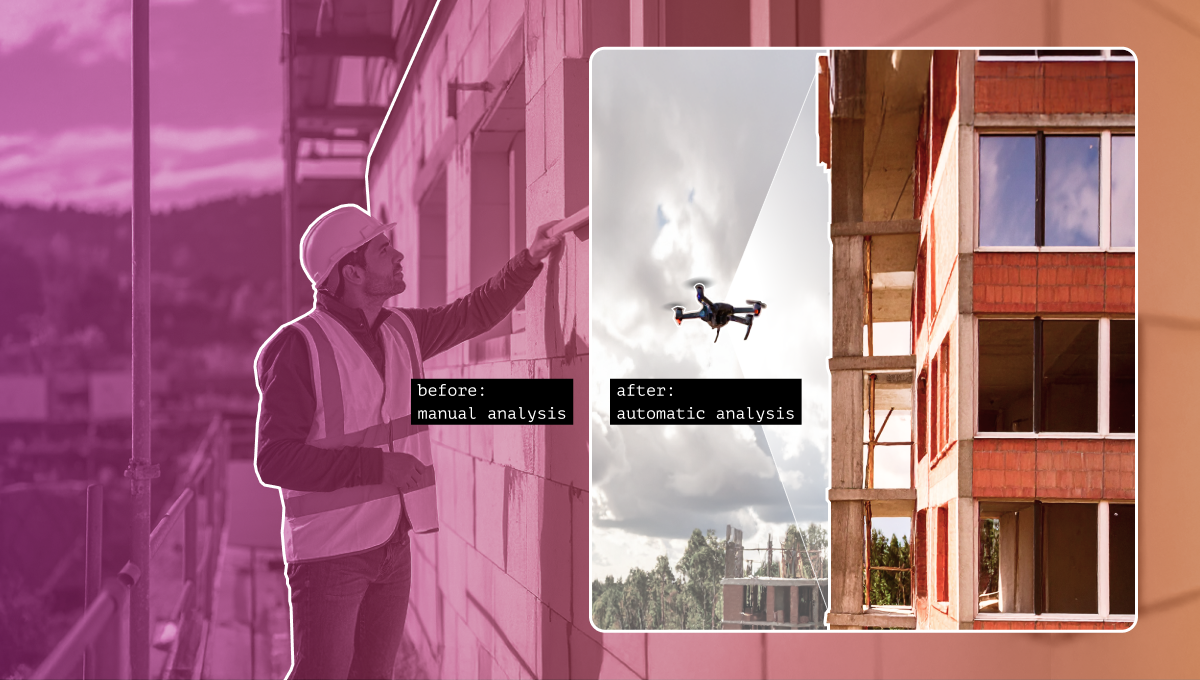
Imagine doing visual checks manually and relying on human memory to spot what’s wrong. That’s the reality many of our clients face when they first come to us. Whether they’re in manufacturing, construction, or telecom infrastructure, they ask the same question in different forms: “Can we automate visual inspection to make it faster, more accurate, and scalable?”
The answer is yes, they can do that with a custom-built AI Visual Inspection System for Quality Control. Using computer vision and machine learning, we build custom solutions that analyze photos or videos to detect defects, validate installations, monitor process stages, and create visual audit trails. These systems are tailored to individual conditions, integrate into existing workflows, and outperform manual methods in both speed and consistency.
In this post, we’ll show how three different clients achieved that transformation. From construction progress tracking, to manufacturing process optimization, to installation verification, these case studies demonstrate how AI is redefining quality control across industries.
Let’s dive right into it.
- 1. What Is an AI Visual Inspection System?
- 2. What Are the Benefits of an AI Visual Inspection System?
- 3. AI Visual Inspection Across Three Sectors Based On Our Work
- 4. Shared Themes Across All Projects
- 5. Insights for a Manufacturer Looking for Photo Validation
- 6. How to Replicate that? Recommended Solution Approach
- 7. Technology Stack Example
- 8. Build a Custom AI Visual Inspection System with DAC.digital
1. What Is an AI Visual Inspection System?
An AI visual inspection system is a solution that uses computer vision and machine learning to automatically analyze photos or videos for quality control purposes. It identifies defects, verifies that assembly and installation steps are completed correctly, measures dimensions, and ensures compliance with specifications, without requiring manual inspection. To learn more, check out one of our previous blog posts: What is AI for Manufacturing Quality Control?
These systems are typically trained on labeled visual data—images or video segments showing correct and incorrect outcomes. Once deployed, they continuously evaluate new inputs from cameras or photo uploads, either in real time or in batch mode, and return actionable results. If you want to learn what’s needed for an automatic system to work, take our 40-minute training: Masterclass in AI Project Management.
Let’s Figure Out If You Have the Right Resources to Build AI Visual Inspection System

Core features of AI-based visual inspection system include:
- Defect detection (e.g., cracks, missing parts, surface anomalies)
- Assembly or installation validation (step completion, correct part placement)
- Dimensional measurement (using calibrated vision to check spacing, alignment, fit)
- Compliance documentation (automated capture of inspection outcomes tied to metadata)
- Automated process monitoring (for continuous quality assurance)
- Version control (linked to project stages or product revisions)
- Single source of truth for all visual data (centralized and searchable)
Subscribe our Newsletter
Anything else we should know?
Optional, and you are already subscribed. It only helps us write for the right reader.
You are on the list.
The next one lands in your inbox. Nothing else — we do not pass your address on.
2. What Are the Benefits of an AI Visual Inspection System?
Key benefits of visual inspection system that’s automated with AI:
- Speed: Processes thousands of images significantly faster than manual QA
- Accuracy: Maintains consistent standards, eliminates subjectivity
- Cost savings: Reduces labor-intensive checks, prevents rework or non-compliance penalties
- Documentation: Creates structured, timestamped visual records for audits and progress tracking
- Scalability: Adapts to multiple lines, sites, or installation teams without scaling headcount
For industries like construction, manufacturing, and utilities, these systems offer complete visibility, historical traceability, and confidence in the quality and compliance of physical work. Now, let’s see three examples of the work of our engineers that developed and/or optimized systems like that.
3. AI Visual Inspection Across Three Sectors Based On Our Work
Oculo’s use of AI and cloud computing to track construction progress and detect issues faster than ever
Oculo, a UK-based construction tech company, captured extensive 360° video footage of building sites to document progress. While this improved transparency, the sheer volume of video made manual processing too slow to deliver live insights. Teams couldn’t extract timely, actionable information, which hindered on-site decision-making and introduced delays.
We introduced a cloud-based, AI-powered video processing pipeline using AWS and Kubernetes. By shifting from a single-machine setup to a dynamically orchestrated cloud architecture, we enabled scalable video analysis with distributed computing. The result? Video processing speed increased by 600x, enabling real-time documentation and validation.
Construction crews could now access live progress visualizations, leave BIM-linked notes on-site, and significantly reduce manual effort in report generation. The system also created a version-controlled, visual audit trail that improved both accountability and compliance.
Read full case study: 600x Faster Processing for an Online Construction Documentation System
Signify’s shift from manual video annotation to automated defect detection and assembly validation
Signify, a global lighting manufacturer, had thousands of hours of industrial video recordings from production lines. However, the manual annotation required to use these videos for AI training was too costly and time-consuming, stalling innovation in process monitoring and optimization.
We developed a tool to automatically extrapolate annotations from a small number of labeled frames to large video datasets. This reduced the need for human labeling while creating usable datasets for model training. The resulting models could detect defects, identify missing components, and measure cycle times for each production step.
With our help, Signify gained the ability to automatically monitor assembly stages, detect errors in real time, and uncover bottlenecks using video data they already had. The system also supports automated chronometry, helping engineers analyze timing and efficiency of production steps.
Read full case study: How Camera Recordings Became a Powerful AI-based Production Line Optimization Tool
Infrastructure: Fibre Optic Provider & Photo-Based Quality Control
A leading fibre-optic provider in the Netherlands relied on manual photo review to validate installations performed by external contractors. The review process was inconsistent, slow, and couldn’t keep up with scale.
Our AI engineers designed a deep learning–based visual inspection model that analyzed photos taken at two critical stages:
- open box (internal wire setup);
- closed box (external installation finish).
The system was trained on a representative dataset selected from 4TB of sensitive field data, using secure transfer methods and cross-validation techniques.
The resulting model delivered 90%+ accuracy, exceeding expectations and enabling automated validation of installation photos. We also implemented Explainable AI (XAI), giving stakeholders clear insight into how the model made decisions. A web interface allowed contractors to upload images and receive real-time validation feedback, while the system maintained a centralized visual record for compliance.
Read full case study: Automated Fibre-Optic Installation Validation with Computer Vision and Machine Learning
4. Shared Themes Across All Projects
Across construction, manufacturing, and infrastructure, each of these projects began with the same starting point: raw visual data. Whether it was 360° video footage from an active construction site, hours of industrial camera recordings from a factory floor, or high-volume photo documentation of fibre-optic installations, all the organizations already had the data they needed. The challenge was that manual inspection, whether of video or still images, had become a clear bottleneck. It was slow, inconsistent, and impossible to scale without significant cost or delay.
That’s where AI made the difference. In each case, we built a tailored solution using deep learning and computer vision to automate what humans had been doing manually. These systems were designed to meet specific business needs, from AI for defect detection in manufacturing, to an automated assembly validation system, to photo-based compliance verification for installed infrastructure. The use of machine learning models dramatically improved processing speed and ensured consistency.
Critically, in sectors where trust and compliance matter (like infrastructure and utilities) we added Explainable AI to show exactly how the model arrived at its conclusions. That transparency helped our clients gain confidence in the system and prepare it for large-scale deployment. Together, these projects show how computer vision for quality control can be adapted across industries, transforming traditional visual quality control into an automated process.
Every Installation Is Right, Because AI Checks It
Ensure every setup is accurate, compliant, and efficient. DAC.digital builds custom AI models tailored to your hardware, installation procedures, and compliance requirements and integrates it into your workflow.
| Dimension | Oculo (Construction) | Signify (Manufacturing) | Fibre-Optic Provider (Infrastructure) |
|---|---|---|---|
| Domain | Construction progress tracking | Manufacturing process optimization | Fibre-optic installation validation |
| Raw Data | 360° video footage | Industrial video recordings | Photographs of installation stages |
| Problem | Too much video for manual/live validation | Manual annotation too costly and slow | Manual photo checks are time-intensive and inconsistent |
| Solution | Distributed cloud processing for faster analysis | AI-assisted annotation extrapolation | Deep learning model for photo validation |
| Goal | Track construction progress, detect defects | Detect errors, optimize production | Ensure installation quality via image analysis |
| Automation Focus | Real-time video processing | Annotation & object detection automation | Photo-based validation at two key stages |
| Visual QA Use Case | Defect & progress validation | Missing components, errors, efficiency | Wire & box state validation |
| AI Methods | Computer vision + DevOps + Cloud | Computer vision + ML + annotation tool | Deep learning + explainable AI (XAI) |
| Impact | 600x faster insights, on-site note-taking | Automated dataset creation, optimization insights | 90%+ accuracy in image-based validation |
| Validation Target | Built environment & progress | Product assembly & part detection | Correct vs. incorrect installation outcomes |
| Scalability Mechanism | AWS + Kubernetes | Few-shot annotation extrapolation | Lightweight dataset + XAI explanation layer |
5. Insights for a Manufacturer Looking for Photo Validation
If you’re responsible for quality control, operations, or any form of visual validation, these projects point to a clear opportunity: you likely already have the visual data you need. What’s missing is the system to make it work for you.
In construction, manufacturing, and infrastructure, we’ve helped clients move from slow, manual inspection to scalable, AI-powered visual inspection systems.
Faster, Smarter Decisions
AI systems can analyze photos or video footage 100x to 600x faster than human reviewers. In high-volume or time-sensitive environments, this means real-time insights instead of hours or days of delay.
Scalable Quality Control Without Scaling Headcount
Instead of relying on manual checks, trained models can process thousands of images or continuous video feeds automatically, detecting defects, validating assembly steps, or confirming compliance.
High Accuracy and Built-In Trust
In one case, we delivered 90%+ accuracy on photo classification. With Explainable AI (XAI), your team can see exactly how decisions are made which is critical in regulated or audited industries.
You Don’t Need a Perfect Dataset to Start
We routinely build production-grade models using only small, representative image sets or what we call a golden dataset. Learn more about it: What is a Golden Dataset?
Tailored to Your Use Case
Whether you need to validate assemblies on the factory floor, monitor site conditions, or document compliance in the field, we build full-stack solutions that integrate directly into your workflow.
Let’s schedule a meeting to discuss it. Contact us here.
6. How to Replicate that? Recommended Solution Approach
Step1
Define Your Use Case Narrowly, Then Expand
Start with 1–2 high-value areas where visual inspection is already being done manually and mistakes are costly (e.g., rework, recalls, compliance fines). It helps if you already collect photos, but if not, don’t worry, you can start anytime.
Example: “We want to automate defect detection for electrical sub-assemblies using photos our operators already take.”
Step 2
Consider if You Need These Core Capabilities in a Solution
| Capability | Why it Matters |
|---|---|
| Image/Video Upload & Inference | Upload photos from phones, cameras, or systems for real-time analysis |
| Custom Model Training | You need models trained on your specific parts/processes |
| Annotation & Labeling Tools | For preparing and refining training datasets |
| Defect Classification | AI model should output pass/fail or type of issue |
| Process Step Validation | Recognize whether a stage is completed correctly |
| Audit Trail/Documentation | Generate timestamped visual records for compliance |
| Explainable AI (XAI) | Show why the AI made a decision (critical for debugging) |
| Edge + Cloud Deployment | Real-time feedback on the line, backed by scalable cloud storage |
Step 3
Solution Types to Consider
| Type | Description | Pros | Cons |
|---|---|---|---|
| Custom AI Solution from a Specialist | Tailored to your use case using your data | Best accuracy, flexible features | Higher upfront cost |
| Off-the-Shelf Vision Systems (like Cognex, Zebra, Neurala) | Prebuilt solutions with some customization | Fast deployment, stable | Less adaptable, may need compromise |
| Hybrid: Platform + Custom Model | Use a platform (e.g. Roboflow, Landing AI, ViDi) with custom training | Good balance of flexibility and speed | Requires internal data team or vendor support |
| In-House Development (with integrator) | Your team builds on PyTorch/YOLO/OpenCV etc. | Full control | Needs strong in-house expertise |
7. Technology Stack Example
If you’re building a robust, explainable, and customizable AI visual inspection system, a typical tech stack might include Python and OpenCV for data processing, with PyTorch or TensorFlow used to train the core computer vision models. For deployment, FastAPI enables fast, scalable web-based inference, optionally containerized with Docker and orchestrated via Kubernetes.
Annotation workflows are supported with tools like CVAT or Label Studio to label a small, representative dataset. To ensure transparency, techniques such as Grad-CAM or SHAP can be used to visualize and explain model decisions.
On the infrastructure side, AWS services provide scalable storage and compute for training and inference. For edge deployments where real-time, on-premise inference is required, hardware options such as NVIDIA Jetson or Intel OpenVINO can be integrated to support low-latency applications.
8. Build a Custom AI Visual Inspection System with DAC.digital
At DAC.digital, we specialize in building custom AI visual inspection systems that are tailored to your specific environment, data, and operational goals. Whether you’re in manufacturing, infrastructure, or construction, we don’t offer off-the-shelf software, we design solutions that work with your actual photos, videos, and workflows.
Our cross-functional teams combine deep expertise in computer vision, machine learning, MLOps, and industry 4.0. We handle the full lifecycle: from data readiness assessment and annotation pipelines to model training, validation, deployment, and secure web or edge-based interfaces for your teams in the field or on the factory floor.If you’re dealing with inconsistent inspections, manual bottlenecks, or underutilized visual data, we turn that into fast, auditable, and scalable decision systems. Whether you need defect detection, assembly validation, or documentation automation, we build what fits your case. Contact us to learn what’s possible.